5 Signs Your Church Has Compromised with Culture
Half of pastors feel limited speaking out on moral issues, Barna found. Here are five signs your church has taken the culture's shape, and the way home.
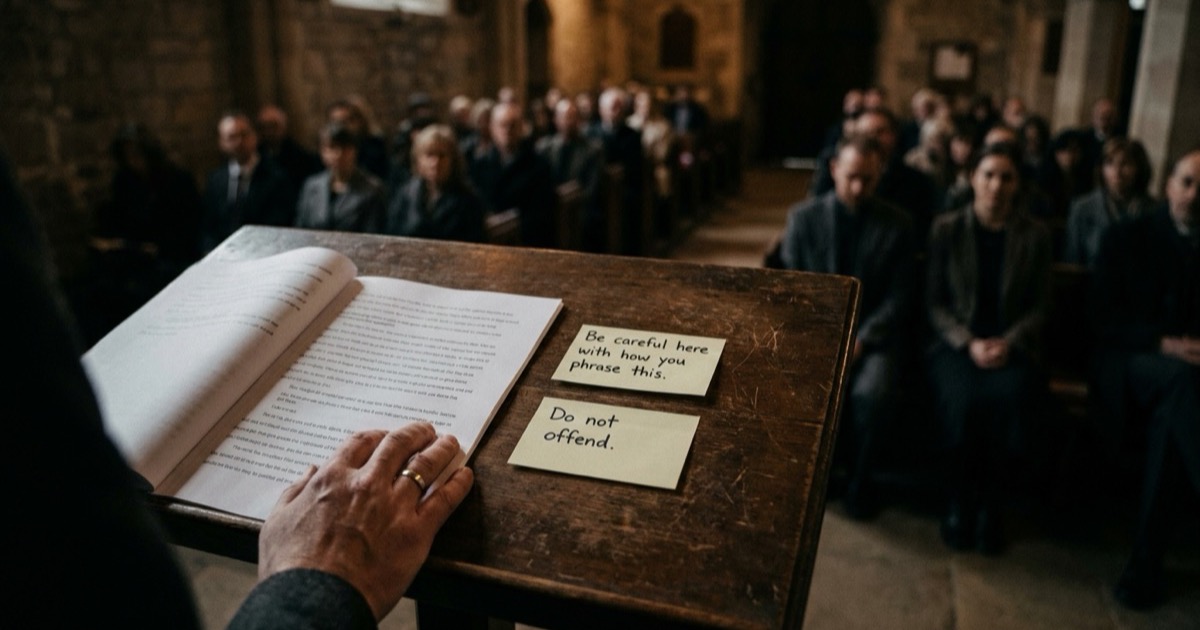
Compromise almost never arrives as a vote. No church schedules a meeting to decide it will stop saying hard things. What happens instead is quieter and slower. A sermon series gets postponed. A phrase gets softened in the retelling. A conviction that was assumed ten years ago is now described as one perspective among several, and no one can name the week it changed.
That is what makes it difficult to see from the inside. You are not looking for an announcement. You are looking for a drift, and drift is only visible against a fixed point.
So here are five signs, offered as a diagnostic rather than an indictment. Run them on your church. Then run them on yourself, because the second reading is usually the harder one.
TL;DR: Cultural compromise shows up as silence, renamed sin, a Bible that gets a vote instead of the final word, a Jesus who is admired rather than worshiped, and gathering treated as optional. Half of pastors say they feel limited speaking on moral issues (Barna, 2019).
Sign 1: Has the pulpit gone quiet where the culture is loudest?
Half of Christian pastors say they frequently (11 percent) or occasionally (39 percent) feel limited in their ability to speak out on moral and social issues because people will take offense (Barna, 2019). The pressure is not coming from outside. Barna found that most pastors say those limitations (64 percent) and pressures (69 percent) come from people inside their own church.
Read that again, because it reframes the whole problem. The culture is not silencing the pulpit. The congregation is.
Notice the shape of the silence. It is selective. A church under cultural pressure keeps preaching hard things, as long as the hard things are unfashionable in ways the surrounding culture already agrees with. Greed still gets named. Pride still gets named. What goes missing is whatever would cost someone a friendship at work.
Paul told Timothy the time was coming “when people will not endure sound teaching, but having itching ears they will accumulate for themselves teachers to suit their own passions” (2 Timothy 4:3). He does not describe teachers who seize control. He describes congregations who assemble the teaching they want. The pulpit goes quiet because the pew asked it to.
If you want the fuller picture of what that costs a pastor, I wrote about it in why pastors won’t preach hard truths anymore.
Sign 2: Has sin been quietly renamed?
The renaming shows up in the data. In the 2025 State of American Theology study, 52 percent of Americans agreed that sex outside of traditional marriage is a sin, 49 percent agreed that abortion is a sin, and 38 percent said people should be able to choose their gender regardless of their biological sex (Lifeway Research for Ligonier Ministries, 2025). On questions the Church answered without hesitation for two thousand years, the country is now split roughly down the middle, and the Church inside that country has moved with it.
Renaming is gentler than denying, which is exactly why it works. Nobody says Scripture is wrong. The words simply change. Sin becomes brokenness. Repentance becomes growth. Disobedience becomes a season. Each substitution sounds more compassionate than the word it replaced, and each one removes the only thing that made grace necessary.
Watch what the new vocabulary does. Brokenness asks for sympathy. Sin asks for a Savior. A church can offer sympathy indefinitely without ever once telling you the truth about your life.
Here is the test. Can your church still say the word sin about something the culture celebrates? Not shout it. Say it, plainly, once, without three paragraphs of cushioning on either side.
Sign 3: Does Scripture get a vote instead of the final word?
Only 49 percent of Americans agree that the Bible is 100 percent accurate in all that it teaches (Lifeway Research for Ligonier Ministries, 2025). Fewer than half. In a country where roughly two thirds still call themselves Christian, the book those Christians claim as authority has been reduced for many of them to a respected opinion.
You can hear this one in how Scripture gets introduced. A compromised church still quotes the Bible constantly. It just quotes it as support rather than as the deciding voice. The verse arrives after the conclusion, brought in to confirm what was already settled on other grounds.
The tell is what happens on collision. Every church agrees with Scripture where Scripture agrees with them. The question is what happens in the room when the text says something the leadership finds costly. Does the text win, or does the text get contextualized until it stops objecting?
Paul’s instruction was “do not be conformed to this world, but be transformed by the renewal of your mind” (Romans 12:2). Conforming is passive. It is what happens to anything left in a mold long enough. No decision is required, which is why so few churches can point to the moment it happened.
Sign 4: Is Jesus admired as a teacher rather than worshiped as God?
This is the sign that should stop us. Among evangelicals in the 2025 study, 28 percent agreed that Jesus was a great teacher but not God. Every one of them had also affirmed that they trust in Jesus Christ alone for salvation (Christianity Today, 2025). More than one in four are trusting for their eternity in someone they say is not God.
The report itself called out the contradiction, describing an alarming lack of biblical literacy and a tendency to hold contradictory beliefs without recognizing the incongruity.
Understand what that means about how compromise works. It does not usually arrive as rejection. It arrives as reduction. Jesus stays central, still quoted, still admired, still called Lord in the songs. He is simply demoted from God to the wisest man who ever lived, and almost nobody notices the demotion, including the people who made it.
A teacher can be appreciated. Only God can be obeyed. And a Jesus reduced to a teacher will never ask you for anything you were unwilling to give, which is precisely his appeal.
Both loyalties feel survivable right up until they are tested, which is the argument at the center of what Jesus meant when he said you cannot serve two masters. His words were “no one can serve two masters” (Matthew 6:24). Not should not. Cannot.
Sign 5: Has gathering become optional?
44 percent of evangelicals say worshiping alone or with family is just as good as worshiping with the gathered church (Christianity Today, 2025). Nearly half of the people who confess Jesus as Lord have concluded that the saints gathering together is a preference rather than a practice.
Scripture is direct here, and it is worth being precise about what it actually says. “Let us consider how to stir up one another to love and good works, not neglecting to meet together, as is the habit of some, but encouraging one another, and all the more as you see the Day drawing near” (Hebrews 10:24-25).
Read what that passage asks for. It describes believers of like mind coming together on purpose to stir one another up, to encourage one another, to lift each other and hold each other steady. It says nothing about signing anything or belonging to an institution. The command is about the gathering itself, willful and intentional, chosen again and again.
That distinction matters. Something signed once is finished. Gathering is chosen every week, with people close enough to notice when you have started to drift and honest enough to say so.
A church shaped by the culture will not argue with you about this. It will hand you the stream, the replay, the app, all of it easier than showing up. None of it can look you in the eye. And a believer who worships only alone slowly becomes the double-minded man of James 1:8, unstable in all his ways, because there is no one left in the room to steady him.
Where do you go when your convictions start to soften and no one has seen your face in a month?
What do you do if you recognized your church?
Start by refusing the two easy exits. The first is pretending you saw nothing. The second is walking out on Sunday with a grievance and calling it discernment. Both cost you nothing, and neither one helps anybody.
Then say the specific thing out loud, to someone who can do something about it. Not a general complaint about the direction of the church. One specific silence, named. Many pastors are carrying more pressure than their people know, and Barna’s finding tells us where that pressure originates: inside the church. Some of these men are waiting for one person to stand beside them. Be that person before you become a critic.
And take the diagnostic home. Every one of these five signs has a personal version. The pulpit that goes quiet has a counterpart in the conversation you have learned to avoid. The renamed sin has a counterpart in the thing you have stopped calling what it is. Institutions do not compromise on their own. They compromise because the people inside them did first, quietly, one small surrender at a time. That is the argument I made in the church is not drifting, it is choosing.
Here is what I want you to hear most, because it is the whole point. None of this is written to condemn you or your church. Compromise is not the unforgivable position. It is a common one, and the response Scripture offers is not shame. It is the way back. Repentance is the door home, and it is still open, and it opens from your side. If you want to know what walking through it actually requires, that is what repentance actually requires.
God has not abandoned his people. His people have wandered, and the watchman is sounding the alarm while it is still today.
Frequently asked questions
Is it wrong to leave a church that has compromised with culture?
Leaving is the last step, not the first. Begin by naming what you actually see, in specifics rather than impressions, and take it to the people who teach and lead. Many pastors are carrying more pressure than their congregations realize. Barna found that half of Christian pastors frequently or occasionally feel limited in speaking out on moral and social issues because people will take offense, and that roughly two thirds of that pressure comes from inside their own churches. A pastor who has gone quiet under that weight may be waiting for someone to stand beside him rather than someone to walk out. Stay long enough to find out. If the softening is settled policy rather than fatigue, and correction from Scripture is unwelcome, then go, and go without bitterness.
What is the difference between cultural relevance and cultural compromise?
Relevance changes the language. Compromise changes the message. A church can preach in plain speech, meet real needs, and address what people are actually living through, and remain entirely faithful while doing it. Compromise begins when the culture starts deciding which parts of Scripture are still sayable. The test is simple and uncomfortable: identify the teachings your church has stopped repeating in the last five years, then ask what those teachings have in common. If they share nothing except that the surrounding culture finds them offensive, the surrounding culture is holding the editing pen. In the 2025 State of American Theology study, only 49 percent of Americans agreed the Bible is completely accurate in all that it teaches, which is the soil that kind of editing grows in.
Can a church that has compromised with culture recover?
Yes, and the path back is the same one offered to every believer: repentance. Not a rebrand, not a new statement of faith posted to a website, not a season of louder preaching to prove a point. Repentance is naming the specific thing that was surrendered, saying plainly that it was surrendered, and turning around. Churches recover when leaders are willing to say what they went quiet about and why, and when the people receive that confession without punishing it. That second half matters more than most congregations admit, because a pastor who fears his own people will not tell them the truth. God’s posture toward a church that turns is not suspicion. It is welcome, and the door home is still open.
The question underneath all five signs is the one my book was written to ask: who actually holds your allegiance? You can read more about You Can’t Serve Two Masters, or get writing like this in your inbox by subscribing to The Remnant, my free biweekly email newsletter.

Drew Reitzel
Drew Reitzel is the author of You Can't Serve Two Masters and founder of Undivided Allegiance. His writing focuses on Scripture, divided allegiance, conviction, cultural compromise, repentance, and the call for Christians to live under the authority of Christ with clarity and unwavering loyalty.