Why Pastors Won't Preach Hard Truths Anymore
50% of pastors avoid moral issues from the pulpit (Barna, 2023). It's not fear. It's a calculated trade that's costing the Church everything.
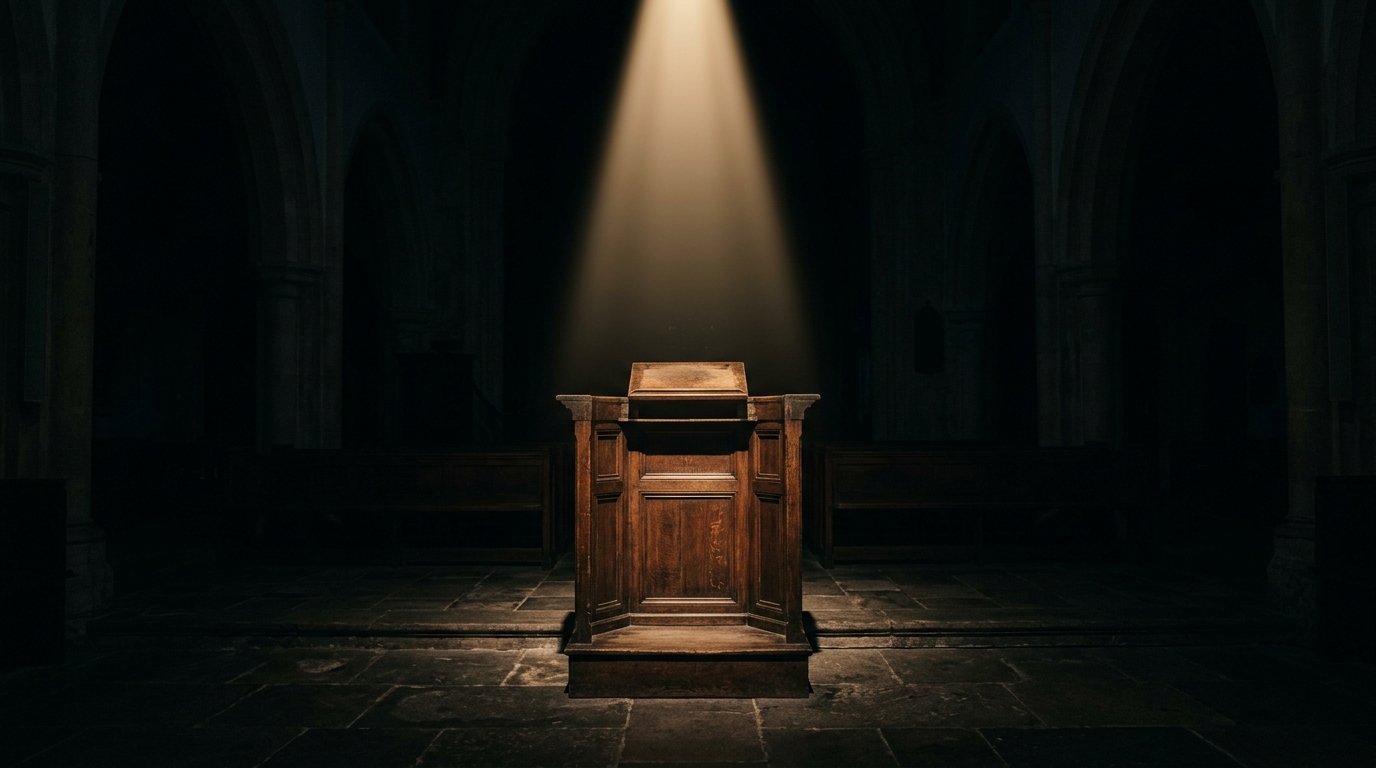
The pastor knows. He has read the text. He understands what it says. And he is choosing not to say it.
That is the crisis: not ignorance, not confusion, not a theological gap. A Barna study found that 50% of American pastors feel limited in their ability to speak on moral and social issues because people will take offense (Barna, 2025). Half. Not because they don’t believe what Scripture says. Because saying it has become too expensive.
What they are calculating, why they keep calculating it, and what the Church loses every time they do: that is what this piece is about.
TL;DR: Half of all American pastors avoid preaching on moral issues because people will take offense, according to Barna (2023). This isn’t about theological uncertainty. It’s a calculated trade: approval and attendance in exchange for prophetic faithfulness. The result is a generation of Christians who’ve never heard the Word applied to the world they actually live in.
What Are Pastors Actually Afraid Of?
American pastors are afraid of the consequences that come from preaching what Scripture actually says on contested issues. According to Barna Research (2025), 50% of American pastors feel limited in what they can say from the pulpit on moral issues, not because of legal restriction, but because they anticipate offense. The fear is specific and rational: say the wrong thing, and people leave. They stop giving. They find another church that will tell them what they came to hear. Pastors who preach with clarity on sexuality, the exclusivity of Christ, the reality of hell, or the political implications of Scripture face real consequences. This is not a new form of fear. But it is a fear that the American Church has allowed to govern the pulpit in a way prior generations of pastors would not have recognized as acceptable stewardship of the Word they were entrusted to preach.
According to Barna Research (Barna, 2025), 50% of American pastors feel limited in what they can say from the pulpit on moral issues, not because of legal restriction, but because they anticipate offense. The fear is specific: say the wrong thing, and people leave. They stop giving. They write letters. They find another church down the road that will tell them what they came to hear.
That fear is not irrational. Pastors who preach with clarity on sexuality, the exclusivity of Christ, the reality of hell, or the political implications of Scripture face real and immediate consequences. Congregants do leave. Budgets do tighten. Staff meetings do get harder.
But here is the thing about fear of men: it has never been a biblical justification for silence. The prophets knew this. The apostles knew this. Paul wrote to a young Timothy, “God gave us a spirit not of fear but of power and love and self-control” (2 Timothy 1:7). He wrote that from prison.
The real problem isn’t that pastors are afraid. Fear is human. The problem is that fear has been given theological cover. Silence has been rebranded as pastoral wisdom: a sophisticated reading of context, a mature sense of timing, a commitment to “meeting people where they are.” What it actually is: a choice to protect what was built rather than steward what was given.
How Did Ministry Become a Metrics Game?
Weekly church attendance in the United States has fallen to 20% of adults, down from 32% in 2000, according to Gallup (Gallup, 2025). The collapse is steeper among active participants: the share of Americans who qualify as “practicing Christians” dropped from 45% in 2020 to just 20% by 2024. When attendance becomes the primary measure of a church’s health, the pastor’s job description quietly shifts from herald to host.
A host’s job is to make people comfortable. A herald’s job is to say what they were sent to say.
Those two jobs are not compatible, not when the message is “repent,” “choose,” or “the road is narrow.” But when your building’s mortgage, your staff’s salaries, and your reputation in the community all depend on the Sunday morning headcount, the math starts to favor the host.
This is how metrics rewired ministry. Not through a single decision, not through a doctrinal vote, but through ten thousand small calculations made over decades about which sermon would bring people back and which one would empty the parking lot.
Attendance-based metrics don’t just affect what pastors preach. They affect what they believe is worth preaching. A pastor who has spent fifteen years avoiding conflict with certain truths starts to believe, on some level, that those truths aren’t essential. That they’re peripheral. That emphasizing them would be unloving. The metrics don’t just change behavior. They shape theology.
What Gets Left Out When the Pulpit Goes Quiet?
When pastors stop preaching on contested biblical topics, congregations develop faith that is sincere but theologically incomplete. Only 4% of American adults hold a biblical worldview, according to the 2026 American Worldview Inventory, and only 37% of pastors do (Barna, 2022). When the shepherd and the flock are standing in the same fog, preaching cannot close the gap. The topics pastors most commonly avoid: sexuality, abortion, the nature of hell, end-times, church discipline, and the exclusivity of Christ. These are precisely the topics where cultural pressure has been highest. The avoidance is not random. It is correlated. Where culture pushes hardest, the pulpit has gone quietest. The result is Christians who know Jesus loves them but don’t know what Jesus requires of them. Congregations who can quote John 3:16 and cannot tell you what the Church historically believed about marriage, death, judgment, or salvation.
Only 4% of American adults hold a fully biblical worldview, a number that has not moved in years, according to the 2026 American Worldview Inventory (AWVI, 2026). Among born-again Christians specifically, that figure rises, but only to 10%. The gap between claiming the name and thinking through the lens is enormous.
And only 37% of pastors themselves hold a biblical worldview (American Worldview Inventory 2022, Cultural Research Center at Arizona Christian University). That’s not a gap between shepherd and flock. That’s the shepherd and flock both standing in the same fog.
What does this produce? Christians who are sincere but theologically hollow. People who know Jesus loves them but don’t know what Jesus requires of them. Congregations who can quote John 3:16 and can’t tell you what the Church historically believed about marriage, death, judgment, or the exclusivity of salvation.
None of this happened by accident. The topics pastors most commonly avoid (sexuality, abortion, the nature of hell, end-times, church discipline, the exclusivity of Christ) are exactly the topics where cultural pressure has been highest. The avoidance is correlated. Where culture pushes hardest, the pulpit has gone quietest.
The pews reflect it. According to a 2025 Barna study (Barna, 2025), 62% of Americans identify as Christian, but only 24% are practicing. That gap (the 38% who claim the name but live without the practice) is partly a failure of preaching. Not entirely. But partly.
Is There a Theology That Makes Silence Feel Holy?
Yes. And it’s worth naming it directly.
It sounds like this: “Love your neighbor.” The pastoral logic runs: if a sermon causes someone to feel judged, condemned, or unwelcome, I have failed to love them. Therefore, the loving thing is to preach in ways that don’t wound. The hard truths can wait until people are ready. My job is to build trust first.
This is not a fringe position. It is the operating theology of a significant portion of the American evangelical church. And it sounds generous. It sounds like pastoral care.
But it is a domesticated version of love, one that removes its most important feature. Real love tells the truth. A doctor who withholds a cancer diagnosis to avoid a difficult conversation is not being loving. He’s being cowardly, and he’s dressing it up as mercy.
The Ezekiel 33 model of the watchman is instructive. God tells the prophet that if he sees the sword coming and fails to warn the people, their blood is on his hands. He doesn’t say “use your best judgment about readiness.” He says: warn them. The responsibility is the watchman’s, not the audience’s.
The theological cover for pastoral silence is not new. Every generation produces a version of it. In the 19th century, it was “social harmony.” In the 20th, it was “not getting political.” In the 21st, it’s “creating a safe space.” The framing changes. The function is the same: permission to say less than the text demands.
What Does Scripture Actually Expect of Shepherds?
Scripture treats pastoral silence not as a neutral option but as a specific failure with named consequences. Ezekiel 34 indicts the shepherds of Israel directly: “Woe to you shepherds of Israel who only take care of yourselves.” The charge is not doctrinal error. It is self-protection at the expense of the flock. Paul warns Timothy that people will accumulate teachers who tell them what they want to hear (2 Timothy 4:3), and his own posture toward preaching is unambiguous: “Woe to me if I do not preach the gospel” (1 Corinthians 9:16). Not “woe to me if people leave.” Not “woe to me if giving drops.” Woe to me if I do not say the thing I was entrusted to say. These texts do not leave room for a metrics-driven calculus. They assume cost. They assume opposition. And they name silence as the failure, not the speaking.
The Bible doesn’t treat pastoral silence as a neutral option. It treats it as a specific failure with specific consequences.
Ezekiel 34 is the clearest text. God speaks to the shepherds of Israel and indicts them: “Woe to you shepherds of Israel who only take care of yourselves! Should not shepherds take care of the flock?” (Ezekiel 34:2). The charge isn’t doctrinal error. It’s self-protection at the flock’s expense.
Paul is direct with Timothy: “For the time will come when people will not endure sound teaching, but having itching ears they will accumulate for themselves teachers to suit their own passions” (2 Timothy 4:3). The word “accumulate” is telling. People don’t stumble into comfortable preaching. They shop for it. And pastors who provide it aren’t meeting a need; they’re feeding an appetite that will hollow out faith.
And Paul’s own posture toward his preaching: “Woe to me if I do not preach the gospel!” (1 Corinthians 9:16). Not “woe to me if people leave.” Not “woe to me if giving drops.” Woe to me if I don’t say the thing I was entrusted to say.
These texts don’t leave much room for the metrics-driven calculus. They assume the cost. They assume opposition. They name the silence as the failure, not the speaking.
What Faithful Preaching Actually Looks Like
Not louder. Not more politically engaged. Not a pulpit that trades in one kind of culture war for another.
What faithful preaching looks like is a sermon that stays tethered to the text, even when the text makes the room uncomfortable. It’s not theater. It’s not confrontation for its own sake. It’s a pastor who trusts that the Word of God is sharper than anything he could construct on his own, and who therefore lets it do the work it was designed to do.
It will cost something. It always has. The prophets paid. The apostles paid. Faithful preachers in every generation have watched people walk away from truth they weren’t ready to hear. That loss is real. It hurts. And it does not change the mandate.
Only 27% of Americans now rate clergy as having high or very high honesty and ethics, according to a 2026 Lifeway/Gallup survey (Lifeway Research, 2026), down from 67% in 1985. And a 2023 Barna study found that 42% of pastors considered quitting ministry in the prior year (Barna, 2023). The weight is real. But there’s a difference between the weight of faithfulness, carrying the responsibility of the Word, and the weight of compromise, carrying the knowledge that you’ve chosen comfort over clarity. One weight produces endurance. The other produces slow collapse.
The question isn’t whether preaching hard truths is costly. It is. The question is whether the pastor has decided that cost is worth carrying, or whether he’s decided the price is too high and built a ministry around the decision.
Frequently Asked Questions
Why do pastors avoid preaching on controversial topics?
According to Barna Research (2023), 50% of American pastors feel limited in their ability to address moral issues because people will take offense. Pastors calculate real consequences: lower attendance, reduced giving, and congregational conflict. While understandable, this avoidance has produced congregations with no framework for applying Scripture to the world they live in.
What topics are pastors most likely to avoid?
Pastors most commonly avoid preaching on human sexuality, abortion, the exclusivity of salvation, hell and final judgment, church discipline, and the political implications of biblical ethics. These topics carry the highest social friction, and therefore the highest avoidance rate among clergy trying to maintain attendance and giving.
Is there a biblical mandate to preach hard truths?
Yes. Scripture treats pastoral silence as a specific failure. Ezekiel 34 indicts shepherds who prioritize themselves over the flock. Second Timothy 4:3 warns that people will seek teachers who tell them what they want to hear. Paul states in 1 Corinthians 9:16 that preaching the gospel is not optional: “Woe to me if I do not preach the gospel.” The mandate is not conditional on audience readiness.
How does pastoral silence affect the congregation?
Only 4% of Americans hold a biblical worldview (AWVI, 2024), and only 37% of pastors do (Barna, 2022). When pastors avoid the hard texts, congregations develop faith that is sincere but theologically hollow: confident in God’s love, unfamiliar with God’s demands. The result is a church that cannot engage culture because it cannot distinguish itself from culture.
There is a sentence in Ezekiel 34 that the modern American pastor should sit with.
“I will hold the shepherds accountable for my flock.”
Not the elders. Not the congregation. Not the culture. The shepherds.
The hard truth (the one nobody is preaching) is that the silence in the pulpit is not the culture’s fault. It’s not the fault of oversensitive congregants or an increasingly hostile media landscape. It’s a pastoral choice, made over and over, in thousands of churches across the country, by men who know better and have decided that knowing better is not enough to make the cost worth paying.
That choice has consequences. The flock bears them.
For more on divided allegiance in the Church, read What Does ‘You Cannot Serve Two Masters’ Really Mean?.
Read about the pattern of institutional drift in The Church Is Not Drifting. It Is Choosing.
If you want to know what silence in the pulpit looks like from the pew, work through 5 signs your church has compromised with culture.

Drew Reitzel
Drew Reitzel is the author of You Can't Serve Two Masters and founder of Undivided Allegiance. His writing focuses on Scripture, divided allegiance, conviction, cultural compromise, repentance, and the call for Christians to live under the authority of Christ with clarity and unwavering loyalty.